
Now that many carriers have met (or indeed exceeded) their original planning estimates for how many FWA customers they could support on their network using lower-efficiency indoor devices, we're seeing carriers add outdoor devices to their portfolio.
This shift enables two major benefits:
- Higher network capacity – more customers can be connected to the same cell tower.
- Expanded addressable market – customers located farther from the tower can now be served.
Both impacts drive increased revenue and monetisation for carriers while improving overall network efficiency. They also lead to happier, consistently connected customers. It's a win-win for both carriers and end user, and a natural evolution that's shaping the next major trend in FWA.
Moving outdoors has its challenges
Indoor FWA device design is relatively simple: the 5G Modem (and antennas) can be integrated into the same unit as the Wi-Fi router, and a single AC power supply is sufficient.
However, moving FWA outdoors introduces new layers of complexity. The solution becomes distributed across multiple components:
- An outdoor 5G Modem (with 5G antennas)
- A power supply unit, typically located indoors, since many homes lack outdoor AC sockets
- An indoor Wi-Fi router to provide the broadband gateway capabilities
- A mechanism to deliver power from inside to outside
- A mechanism to transfer data between the indoor Wi-Fi router and the outdoor 5G modem
Traditionally, Ethernet and Power over Ethernet (PoE) have been used to connect these components.
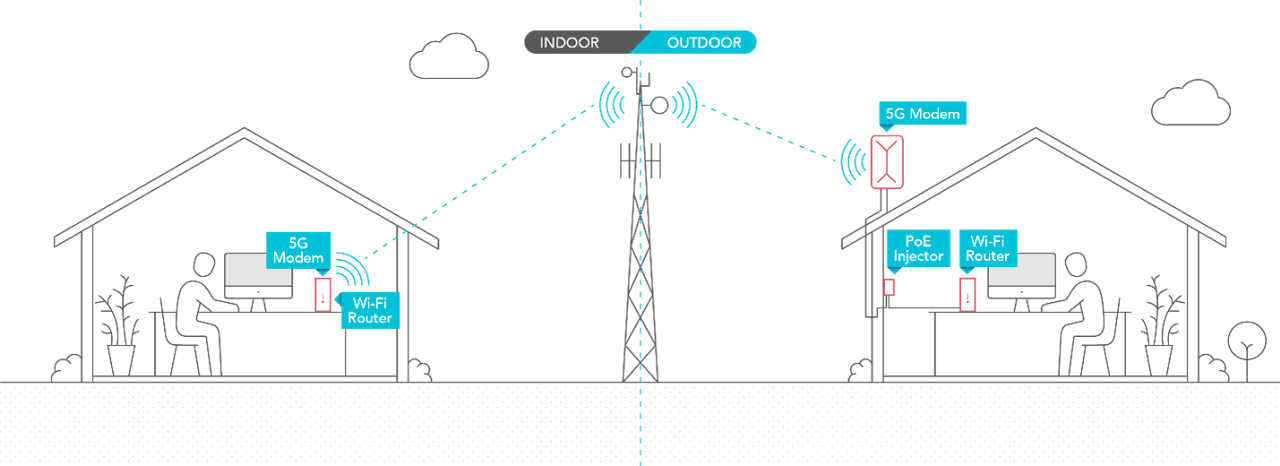
Traditional technician-installed Fixed Wireless Access
Outdoor 3GPP-based FWA deployments have been commonplace since 2012, typically installed by technicians. The complexities of distributed solutions were removed as obstacles for end users, since technicians handled siting, cabling and drilling holes where necessary.
As outdoor FWA volumes increased, carriers began reducing the need to drill through external walls for PoE cabling – both to power the outdoor modem and to interconnect it with the indoor gateway.
To avoid drilling, many deployments began using an existing feature present in every building: the window. Instead of traditional round Ethernet cables, carriers shifted to flat Ethernet cables, which can be placed through an open window and remain in place when the window is closed.
This trend originated with technician installations to reduce time on site, and later enabled outdoor self-installation, where end users could deploy their own outdoor modems.
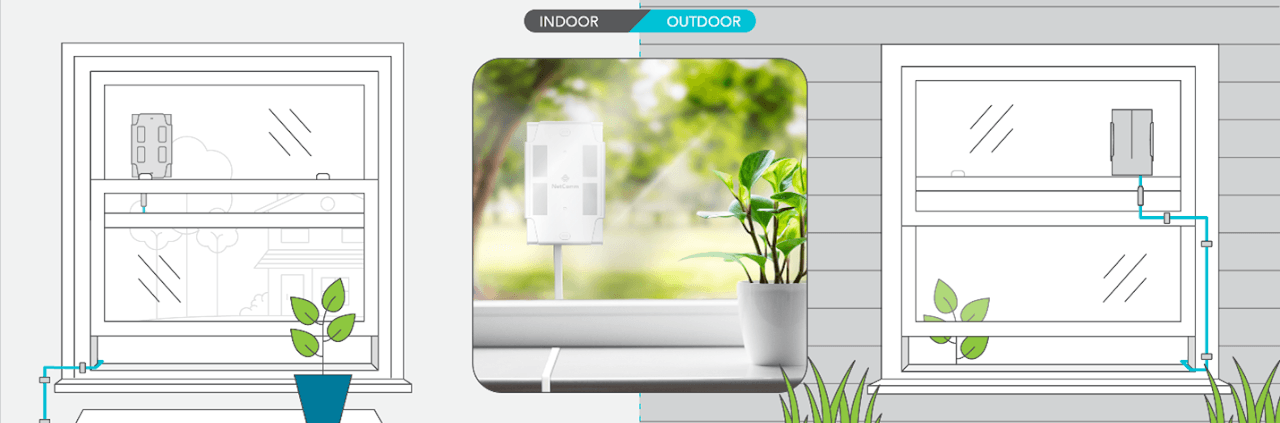
Flat cabling is not universal
Whilst flat cabling is a proven and widely used solution, it has not achieved universal acceptance across all markets or housing types.
Pros
- Simple solution using standard PoE architecture and technology, no complex or novel innovations required.
- Cheaper than drilling holes, and cheaper than other technology solutions.
Cons
- Limited availability of weatherproof, UV protected flat Ethernet cabling
- Higher cable cost compared to traditional round cabling
- Carriers often must supply the flat cable; users needing longer cables may face placement limitations
- Some window types (though relatively rare), particularly those with thick rubber seals, are not suitable for flat cabling
- Homeowners concerned about energy efficiency may hesitate to run cables through closed windows, even though flat cables typically have minimal impact
"Through Glass Power" technology
In recent years, we've seen innovations in cable-free power transfer – most notably the rise of wireless phone charging pads using inductive technologies.
Building on this research, it is now possible to transmit power through a window without a cable. However, windows introduce added complexity compared to charging pads because they vary widely. A solution designed to transmit power through glass windows must dynamically assess window characteristics and adjust accordingly, ensuring the outdoor device receives sufficient (but not excessive) power with optimal efficiency.
This dynamic capability enables a single CPE platform that can be deployed globally, regardless of window variation. The system can automatically adapt to:
- Single-, double-, or triple-paned windows
- Low-E coating types
- Different inert gas fills
- Varying glass thicknesses and air gap distances
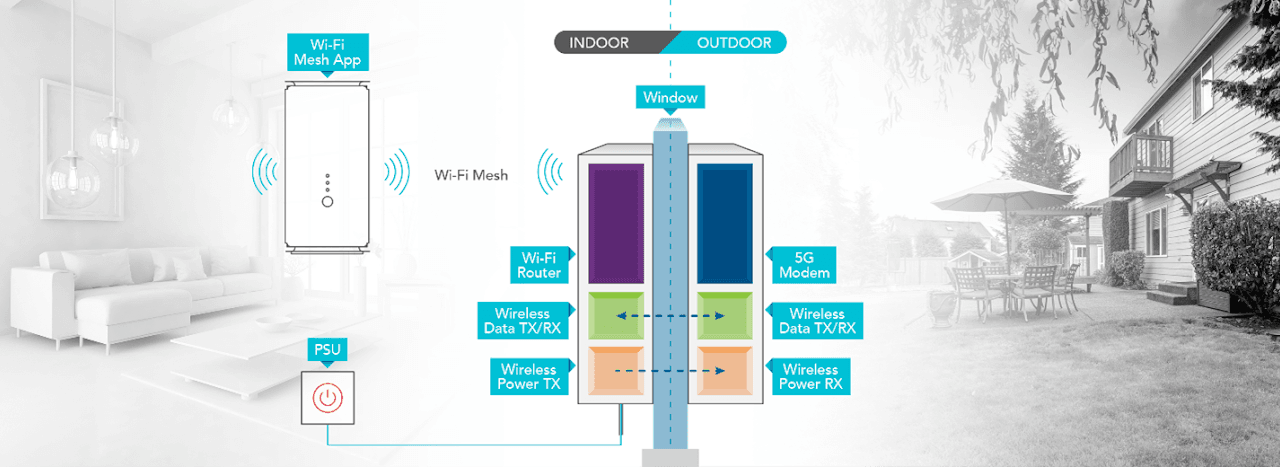
For data transmission, several cable-less solutions already exist and integrate well with FWA architectures, allowing data to be transmitted through glass.
NetComm and Solace: Partnership on Through Glass Power
NetComm, a global leader in 5G Fixed Wireless CPE, and Solace, a global leader in wireless power and data transfer technology, have entered into a collaboration agreement.
Under the agreement, Solace will provide its patented through glass power platform to enable NetComm's next generation of self-install outdoor CPE to become completely cable free.
Learn more:
NetComm: Multiple outdoor offerings
NetComm's latest 3GPP-based 5G outdoor FWA devices build on an 18-year history of FWA innovation. NetComm solutions have supported some of the largest and harshest outdoor FWA deployments worldwide. With proven offerings for both self-installation and technician installation, NetComm helps FWA providers navigate the intricacies of selecting the right device for their deployment strategies.
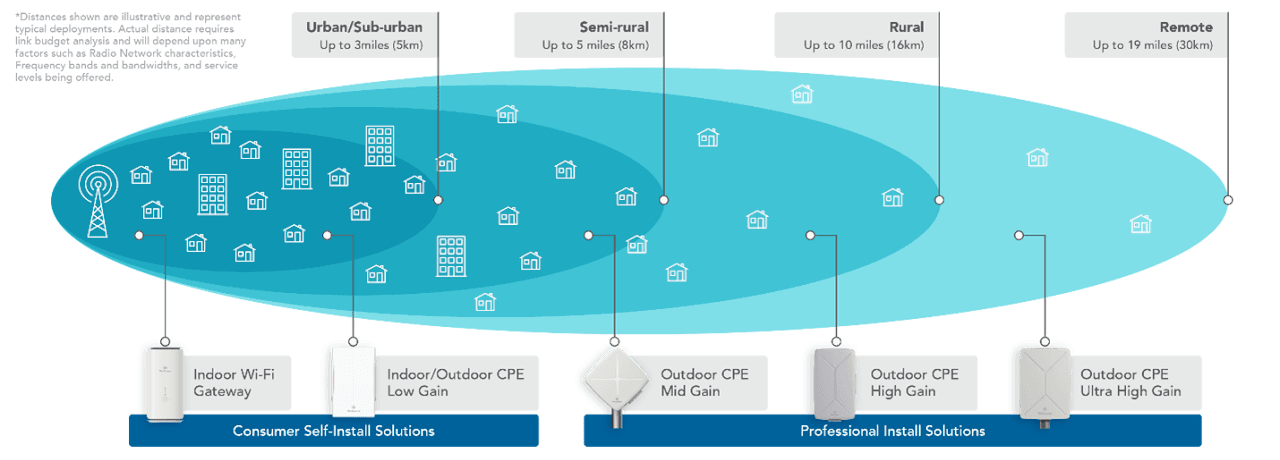
Ready to boost your connectivity? Explore our innovative Fixed Wireless Access solutions, designed for high-performance across urban, suburban, and even remote rural environments.